

Native Plant Projects
Individual Plants
Sun Plants
Common Milkweed*
Rose Milkweed
Anise Hyssop
Black Eyed Susan
Dense Blazingstar
Lanceleaf Coreopsis
Purple Coneflower
New England Aster*
Showy Goldenrod*
Riddell's Goldenrod*
Plants that Tolerate Partial Shade
New England Aster*
Purple Coneflower*
Shade Plants
* Plants that are considered keystone plants by the National Wildlife Federation and play an important role in the life cycles of native bees and birds.
Insta Garden Options
Combo One: Beautiful fall blooms that support migrating birds and butterflies. Best in full sun, tolerates drought. New England Asters and Showy Goldenrod
Combo Two: Classic summer prairie! Purple coneflower, Common milkweed, Anise hyssop
Combo Three: Smaller bedding plants-- natives that will fit nicely in borders mixed with annuals! Butterflyweed milkweed, button blazing star, Riddell's goldenrod
Winter Sowing Timeline:
January 1- Feb 15: Right now you should be making your winter sowing containers and starting your seeds. Read the Winter Sowing Basics if you haven't started. If you received a Native Garden Starter Pack at one of our events, just make sure it is outside experiencing the winter weather. You don't need to do anything. Check back in mid- February for more information.
Feb 15- March 15-- This is the time when you should start checking on your plants every few days. Depending on the type of seed and the location of your winter sow packs, you may start to see sprouting at this time. If so, just make sure that you remove the lid before your plants hit their head on it. If there is no sprouting at this time, that's okay! Some seeds might not sprout for another few weeks. Just keep an eye on them and make sure that they don't dry out. Spring will be here soon!
March 15- April 15-- Many of your plants should be starting to come up now. Make sure that they are staying moist, but not drowning in our rainfall.
April 15- If your plant has at least 3 leaves, and you can put the whole peat pellet in the ground and bunch dirt around the top, and still see a bit of the plant's leaves, you can plant it. The most important thing is that the peat pellet has to be totally covered. If it isn't, moisture will get pulled out of the pellet where it is exposed and the pellet will dry out even when the rest of the soil is moist. This can dry out your plant roots and cause it to die. Your garden is started! Happy Spring!
Winter Sowing Basics

Examples of usable containers.
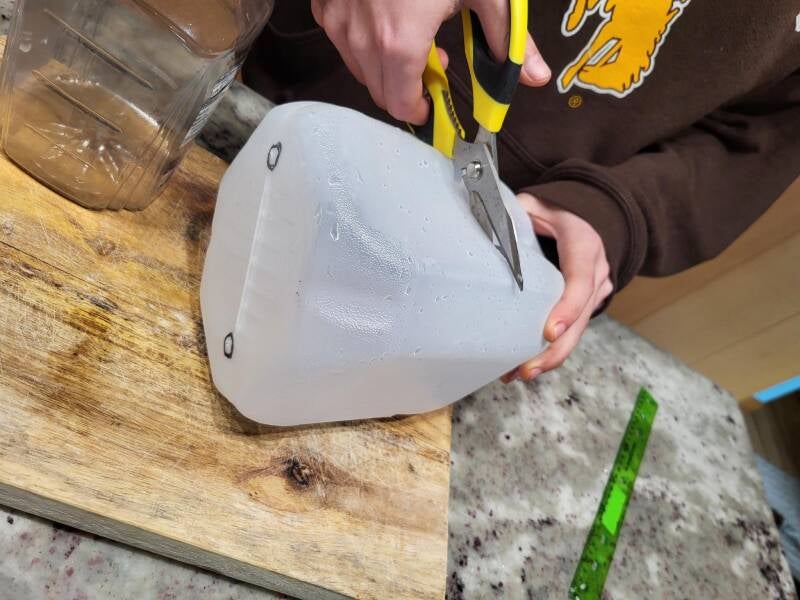
Poke 2 holes in bottom (circled in black here, and cut container if necessary for removing plant after it grows.

Add at least 2-3 inches of seed starting material. Coconut coir is pictured here.

Sprinkle seeds, but not too densely.

Various containers prepared and placed. Notice that they are labeled.
What is Winter Sowing?
Winter Sowing is a way to grow native plants from seeds.
Why do we use this method?
While crop plants like beans and squash have seeds that sprout easily when planted, many of our important native plants evolved to require special circumstances to germinate. For example, some sprout only when they have gone through the digestive tract of a bird, or after being kept wet and cold for a long period of time. Winter sowing is a way to give the seed what it needs without requiring the grower to have a lot of special knowledge about each species of plant.
How does it work?
1. Prepare a container that has a clear lid by poking a small hole or two in the bottom. This will drain any excess water. Then, poke a hole in the lid. This will allow excess heat to escape. If your container already has a small opening in it (for example a milk jug or 2 liter bottle that you have cut in 1/2.) simply remove and discard the lid.
2. Add at least 2- 3 inches of a seed starting medium. (Coconut coir or a store bought seed starting mix are both good. Peat will work, too, but be aware that peat is a non-renewable resource.)
3. Add water, making sure your starting medium is saturated, but not over- saturated.
4. Place your seeds on the starting medium and push them in to make good contact. It's okay if they are buried a little, but the goal isn't to bury them. It is to make sure the moisture from your starting medium works its way into the seed. Seeds will often work their way down during the freeze/thaw cycles after you are done. So, don't worry about this right now.
5. Place the top on your container. If you've cut a jug or bottle in half, you will need to tape the 2 halves together. If you have a container with a clear top that can be secured (snaps on or screws on,) you do not need tape. Label your container with the name of the plant using a waterproof marker.
6. Place your container OUTSIDE. Yes, outside in the cold and the snow. Find a spot that is sunny at least part of the day and where the wind isn't especially strong, and then just leave your seed container out there.
7. Beginning in late March or early April, start checking on the plants. Once they have begun to sprout, you'll need to keep checking on them and open the container once they start growing so they aren't smashing up against the lid.
8. They will be ready to plant by May 1st. Check back here for more tips on planting later this spring.
Let's Grow Native, Worthington
Phyte Club is partnering with the Worthington Green Team to promote planting native gardens in our neighborhoods. You can learn more about the project here: https://www.experienceworthington.com/green-lets-grow-native .
In addition, look for us around the city as we put on events to help build the biodiversity in Worthington.
Annual Spring Fundraiser
Phyte Club-- the student group that manages the garden-- spends each school year raising native plants as our main fundraiser. We collect, cure, sort, store, and stratify the seeds. We plant them according to their unique growing needs. We nurture them with only natural, regenerative growing media and fertilizers. Finally, we sell them to you! Check back here in spring for a list of what we are growing and a chance to preorder.